Start with the period you are reviewing. In Paycheck Budget, the current window ends the day before the next planned payday. A bill due on payday belongs to the next period, and an overdue active bill remains reserved. These are this tool's rules, not instructions to delay or prioritize payments.
Build a bill list before doing the calculation
- Write down the next expected pay date and check it against your employer's actual schedule.
- List bills due before that date, keeping already-overdue unpaid amounts visible.
- Check the amount still unpaid on each occurrence, including any partial payment already made.
- Keep cash already received separate from expected income. Add an explicit reserve for variable spending inside the window.
You can organize the dates first in the free Bill Calendar. It does not calculate cash coverage; the example below shows that separate step.
A worked window
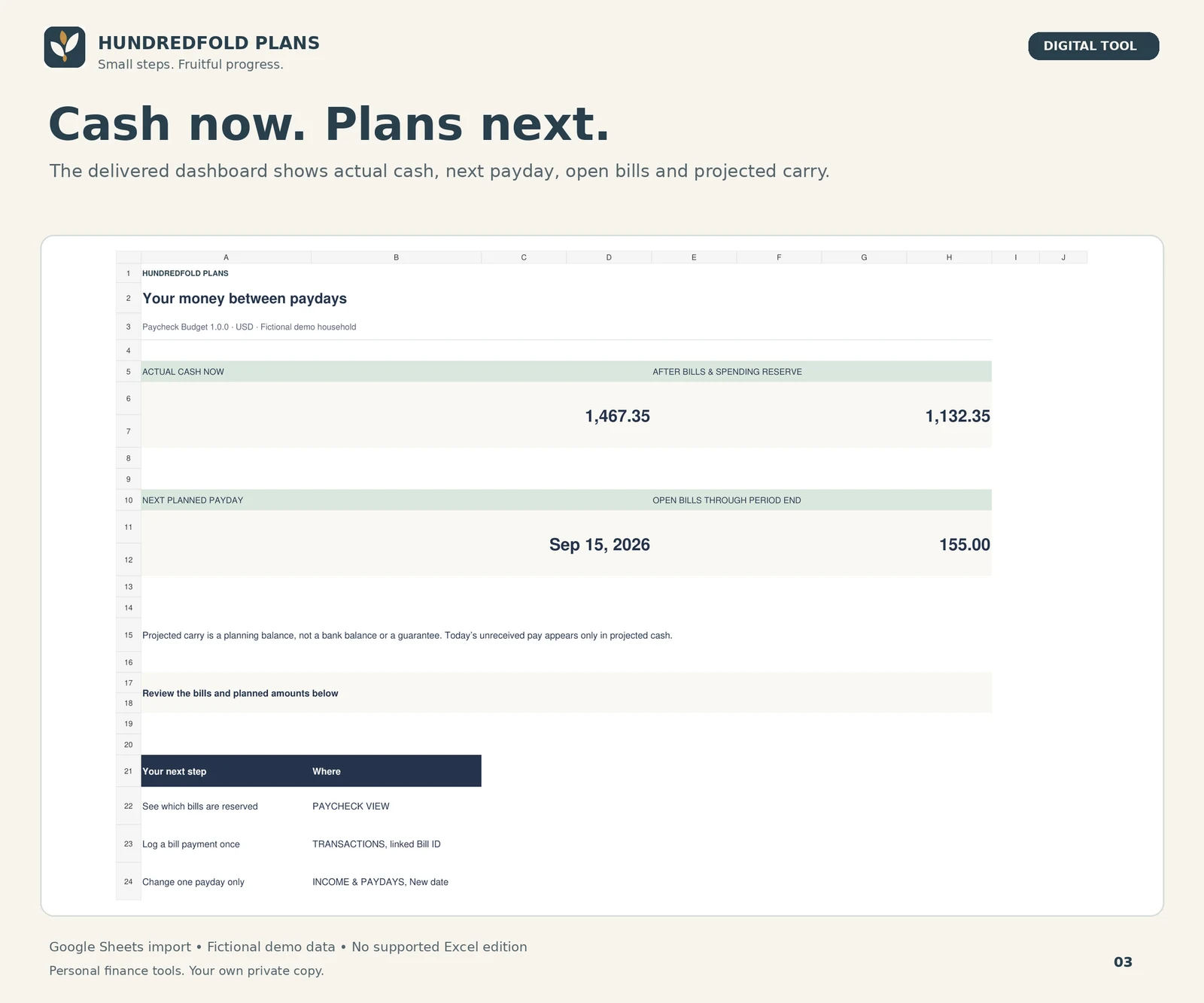
On September 10, 2026, the fictional household's next planned payday is September 15. It has $1,467.35 in actual cash and $155 of open bills through September 14. A $180 variable-spending reserve is entered for the window.
| Item | Amount |
|---|---|
| Actual cash now | $1,467.35 |
| Less open bills through September 14 | $155.00 |
| Less variable-spending reserve | $180.00 |
| Projected carry | $1,132.35 |
This example has no additional unreceived income inside the window. In other cases, inspect which planned income the projection includes. Money expected later is not cash already received.
Why a monthly total is not enough
A month can contain more than one payday. The month's total income and bills do not tell you the order in which they occur. Read the actual dates, especially when two income sources have different schedules. Compare biweekly and semimonthly dates.
When the bill is paid
Record an actual payment once and link it to the bill occurrence. In the example, paying internet at $65 reduces cash to $1,402.35 and open bills to $90. The carry remains $1,132.35. If cash falls but the bill remains fully reserved, check the Bill ID and the recorded payment before drawing a conclusion. Read planned versus actual.
Before your next review
Confirm the opening cash scope, received-income status, actual dates and remaining bill amounts. Add future occurrences manually. If no future payday is available, read the labeled fallback window instead of assuming it is a normal payday period. This is a planning view, not a bank reconciliation service.
Watch the example or check Paycheck Budget's limits. For bill dates alone, the Free Bill Calendar is a smaller starting point.