Debt snowball and debt avalanche use different rules for where extra repayment goes. Snowball starts with the smallest balance. Avalanche starts with the highest interest rate. Comparing them in a spreadsheet is most useful when the starting balances and payment budget stay the same.
Two debts, two first targets
This fictional example explains ordering only. It does not predict a payoff date or total interest.
| Fictional debt | Starting balance | Fixed annual rate | Fixed monthly minimum |
|---|---|---|---|
| A | $500.00 | 8% | $25.00 |
| B | $1,500.00 | 20% | $50.00 |
Suppose the monthly payment budget is $175: $75 in minimums plus $100 extra. Snowball directs the extra toward A because its balance is smaller. Avalanche directs the extra toward B because its rate is higher. Both comparisons still include the minimums on the other debt. A full schedule also needs interest, payment timing and the treatment of freed payments; the priority table alone is not that schedule.
The US Consumer Financial Protection Bureau's debt action plan explains both ordering approaches. Smaller balances can make progress in the number of debts easier to see; targeting higher rates focuses on interest cost. Your own circumstances and terms still matter.
Keep these inputs equal in the comparison
- Starting balances, rates and minimum payments.
- The total amount available for payments in each modeled month.
- The interest convention and rounding.
- The model horizon and whether any balance remains at its end.
If you raise the payment budget for one method, the difference also includes that extra money. To study the ordering alone, hold the budget constant. To study a larger extra payment, change it for both methods and compare with a saved earlier scenario.
What the Hundredfold spreadsheet models
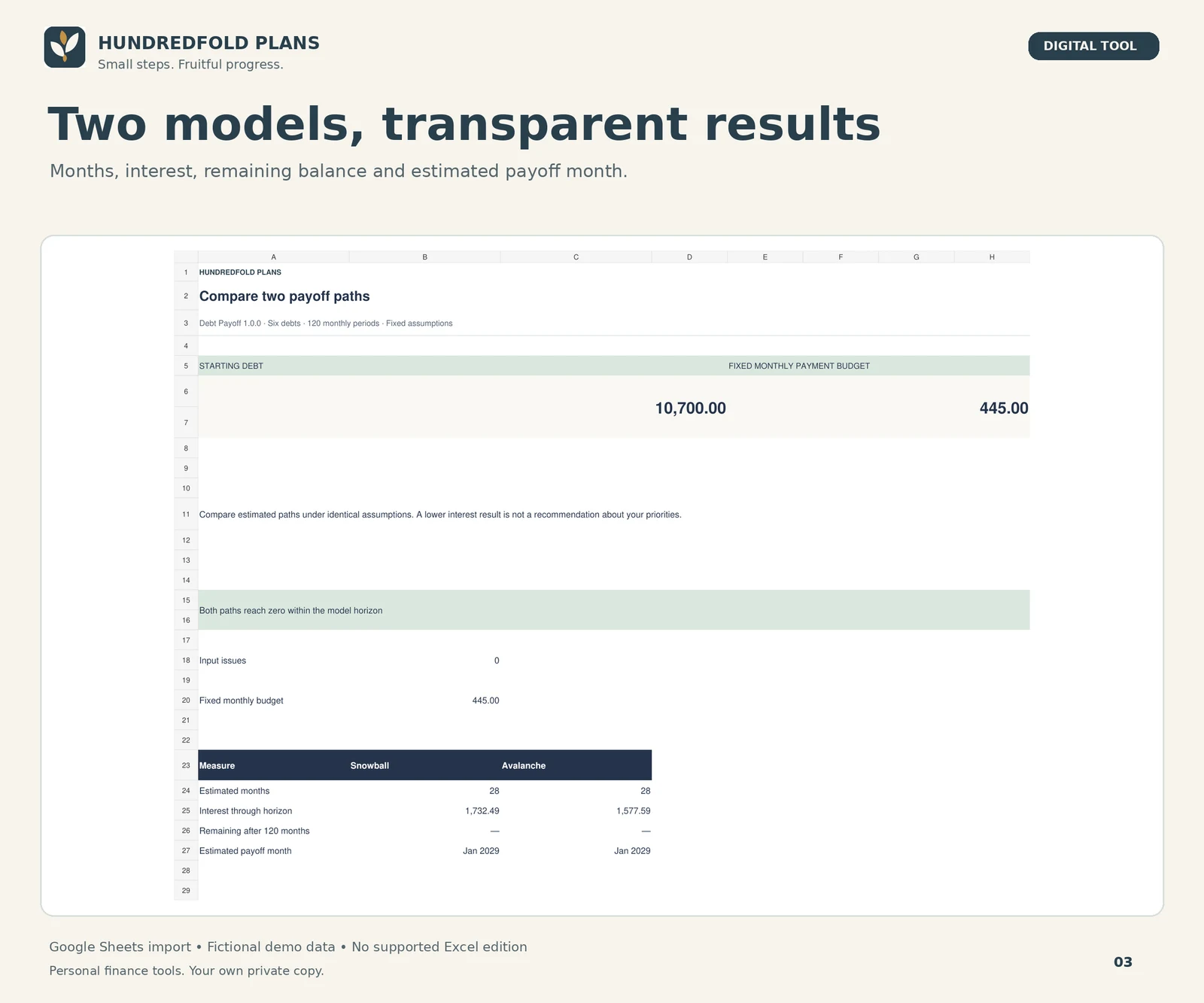
Debt Payoff compares the two schedules for up to six debts over 120 monthly periods. It uses fixed APRs and minimum payments, rounds monthly interest to cents before payment and carries freed minimums forward within a fixed payment budget. It does not include fees, new charges, daily-interest lender calculations or changing terms.
Its fictional demonstration increases the extra payment from $150 to $250 and shows the recalculated views. That is a scenario change, not a promise about repayment speed. Inspect remaining balances and warnings; reaching the last row is not proof of being debt-free.
When a spreadsheet is useful
Use the comparison to understand entered assumptions and review one change at a time. A lender statement remains the source for actual amounts and terms. The spreadsheet does not make payments, contact creditors or decide which obligation you should prioritize.
You can view the Debt Payoff example, download contents and compatibility before choosing a tool. If your question is which bills arrive before payday, read the separate cash-timing guide.