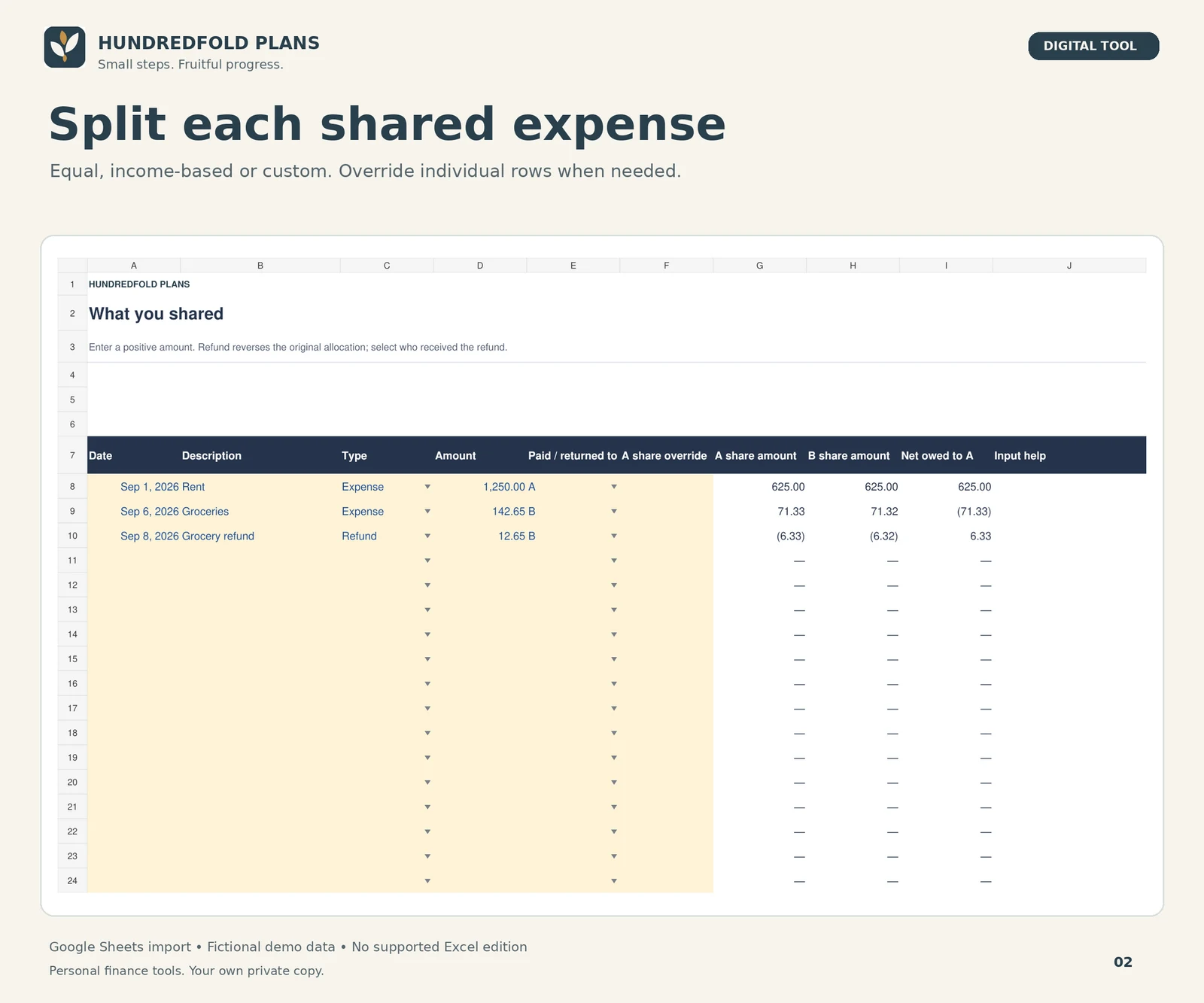
A useful shared-expense record separates three questions: what did the household spend, what share did each partner agree to cover, and who actually paid? A later transfer between partners settles the difference; it does not create another household purchase.
Agree on the period and what is shared
Choose one review period and decide which purchases and refunds belong in the shared record. You do not need to include private spending just because it appears on the same account. Agree on equal, income-based or custom shares and note exceptions for individual expenses. A spreadsheet can apply that agreement, but it cannot decide what is fair.
A worked income-based split
Suppose Alex and Sam agree to use recorded monthly incomes of $3,000 and $2,000 for this example. Combined income is $5,000, so their agreed shares are 60% and 40%. These are fictional figures, not a recommended household arrangement.
| Partner | Agreed share of $1,380 shared costs | Actually paid | Difference |
|---|---|---|---|
| Alex | $828.00 (60%) | $1,080.00 | Paid $252.00 above agreed share |
| Sam | $552.00 (40%) | $300.00 | Paid $252.00 below agreed share |
A completed $252 transfer from Sam to Alex settles this example. Shared spending remains $1,380. If the agreed split were 50/50 instead, each share would be $690 and the transfer would be $390. Changing the agreement changes the calculation; it does not change who paid the original bills.
Record the purchase and transfer separately
Keep each shared purchase or refund with its date, payer and agreed share. Record a completed transfer in a separate settlement record. Review remaining amounts after transfers, and do not add a partner transfer as another shared expense.
The Couples Budget spreadsheet supplies SHARED EXPENSES and SETTLEMENTS for these separate records. Its own fictional demo is a different example: a transfer changes from $300 to $560, the remaining $260 settlement becomes zero and net shared spending stays $1,380.
A refund can change the settlement
Extend the fictional 60/40 example above: before any partner settlement, Alex receives a $100 refund for an included shared purchase. Both partners agree that the refund belongs in the same review period and keeps the original sharing rule.
| Measure | Before the refund | After Alex receives the refund |
|---|---|---|
| Net shared spending | $1,380 | $1,280 |
| Alex's net payments | $1,080 | $980 |
| Sam's net payments | $300 | $300 |
| Alex's agreed share, 60% | $828 | $768 |
| Sam's agreed share, 40% | $552 | $512 |
| Remaining settlement from Sam to Alex | $252 | $212 |
The refund reduces shared spending. It is not a completed transfer from Sam to Alex. Keep the original purchase, the refund and any actual partner settlement identifiable so you can explain the result.
If the refund arrives after you have already settled or closed the review period, agree how to handle that later adjustment and preserve the earlier record. Do not silently assume the table above still describes the remaining amount. Use the Couples Budget instructions for the actual refund and settlement entries; the example illustrates the allocation arithmetic rather than changing your agreement.
What if your split changes?
In Couples Budget, changing the default recalculates rows without overrides. Preserve a particular row's earlier agreed share with an override before changing the default. Use one agreed review period per copy and keep history when starting a fresh one.
The file supports equal, income-based and custom defaults, per-expense overrides, up to 200 shared entries and 60 settlements. It does not access private accounts, move money or synchronize with another workbook.
Two pay schedules are a different question
If you already agree on the shares but need to see which bills fall between two pay dates, read which bills are due before the next paycheck. Paycheck Budget handles regular income timing; Couples Budget handles allocation and settlements.
For a shared-cost record, see the Couples Budget demo, included files and setup. For due dates alone, the Free Bill Calendar is a smaller starting point.